





0.25 CIP Points


Responding to disasters
IN SHORT During a major disaster event, claim numbers can be triple or quadruple usual volumes, so insurers need a comprehensive plan that allows them to scale up their operations quickly. Communication with customers before, during and in the immediate...
 24 Aug 2023

 4 mins read
IN SHORT
- During a major disaster event, claim numbers can be triple or quadruple usual volumes, so insurers need a comprehensive plan that allows them to scale up their operations quickly.
- Communication with customers before, during and in the immediate aftermath of an event is crucial, and claims teams often draw on staff from other parts of the business to help.
- Insurers use cash settlements and fast-track approvals for building and repair works to get claims settled as quickly as possible.
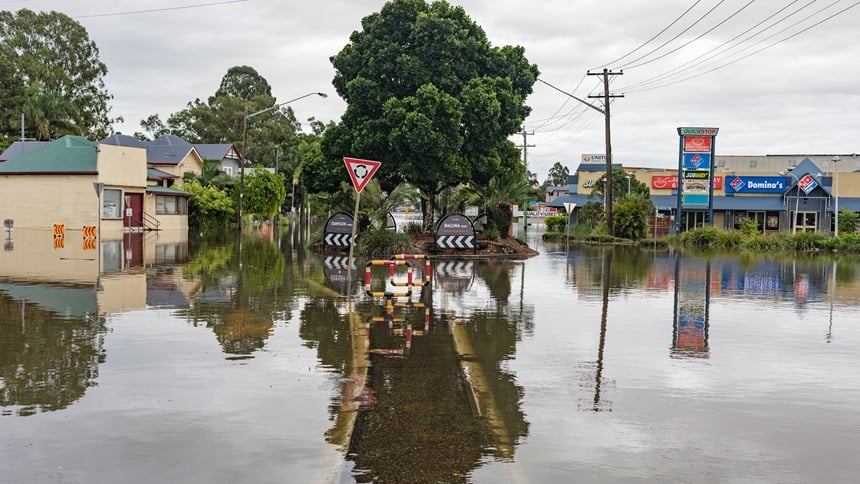
During the latest floods in the New South Wales town of Lismore, IAG’s executive general manager Direct Claims Luke Gallagher travelled with a small army of IAG claims managers to the disaster zone to offer personal support to customers.
He recalls sitting face to face with a couple who had been rescued from the roof of their two-storey house. While they were waiting for help, they had also managed to pluck a neighbour out of the floodwaters, saving her life.
In almost three decades working in the claims space, Gallagher has been on the ground in some of the worst-impacted areas in the immediate aftermath of a disaster. During that time, he says he has seen a lot of change, “including the frequency and severity of major events”, but one key lesson remains a constant: “The best thing an insurer can do is to make sure they’ve got a very robust plan that allows them to scale quickly and introduce digital lodgements to take the pressure off the claims team,” he says.
When disaster strikes
At IAG, there’s a documented plan for major events that the entire organisation uses when disaster strikes, and sometimes, even beforehand.
“We’ve got a dedicated natural hazards and natural perils team that includes meteorologists, scientists, mathematicians and hydrologists that help us understand weather patterns and give us a really clear indication around forthcoming events, and the potential scale and criticality of the event,” says Gallagher. “That helps us invoke the major event plan.”
Prior to the recent events, meteorologists and hydrologists on the IAG team were able to identify risk in advance and pinpoint specific areas that were most likely to see flooding. This enabled text messages to be sent to customers, both to warn of the risk and to provide a link that customers could use to lodge a claim immediately after the event.
This meant the team could ready itself, knowing the shape and scale of what was approaching.
Gallagher says IAG’s major event plan is regularly practised through simulations within the organisation to ensure that when real events occur the business is ready.
“The dedicated major events team has a proven ability to support the rapid scale-up to an extra 200 or 300 claims consultants,” he says.
“We have what’s called an ‘all hands on deck’ approach, so digital lodgements can go to people outside our claims team and across the business … people in sales, service or strategy come on board to help us scale up as fast as possible.”
AA Insurance in New Zealand has been going through a similar program of efficiency and productivity improvements as a result of its learnings over many years. These improvements have helped its claims teams cope with major events, including the Auckland floods in January 2023 and the more widespread damage caused by Cyclone Gabrielle just a few weeks later.
“Customers need to be able to get hold of you immediately when something really terrible happens,” says Simon Hobbs, general manager Operations at AA Insurance New Zealand.
“We swarm the whole business around these events. We pull in staff from every corner of the business — including the Suncorp New Zealand and Australia teams — to support customers who need to make a claim. We also enable customers with less urgent business to lodge claims online, in a really simple and effective process.”
That frees up the claims teams to focus on those who need immediate assistance.
“Within four days of the Auckland event, our call stats were back to normal,” says Hobbs. “That meant customers who really needed us could get hold of us.”
That human element
Scaling up claims operations when major events occur has been one of the major learnings for insurance companies during the most recent disasters.
According to Hobbs, the process begins with a trained triage team to filter calls. Using humans rather than an interactive voice response system at this entry stage means customers who require urgent help, as well as vulnerable customers, can be identified and prioritised.
As more claims are lodged, AA Insurance brings on board a specialist project management company that works exclusively with AA Insurance and Suncorp in New Zealand. That business is also able to scale at pace and has worked closely with AA Insurance during many events to have assessments completed as quickly as possible.
Similarly, IAG adapted its approach to make lodging and processing claims easier and faster during the recent New Zealand weather events.
“Our ‘all hands on deck’ program was activated, enabling a large team to be available immediately,” says Gallagher. “We also trained several hundred more of our people to join them, including 200 contractors from New Zealand and Australia, to help manage claims. Support was also brought in from Australia so we could strip out and dry more homes, faster.”
Making cash king
AA Insurance has settled over half of the contents insurance claims from both recent events with cash.
“In these situations, we just have to be really pragmatic around it,” says Hobbs. “We estimate the value of the contents with a customer and reach an agreement on the settlement, rather than making traumatised people complete lists. The right thing to do is just pay out the sum insured really quickly, if that’s what the customer opts for, and allow them to move on.”
IAG also fast-tracks approvals for work being done by disaster recovery businesses such as builders and automotive repairers during and following disasters.
“We have over 400 property and motor assessors nationally that we can fly into the relevant areas,” says Gallagher.
“We also have a dedicated national repair model, with national-scale builders and smash repairers. We have the ability to move builders into areas that are worst impacted, but always under the premise that those builders will, in the first instance, engage suitably qualified local trades, to give back to the community.”
Empowering partners
To enhance the speed of repairs and unlock other efficiencies, IAG also works with what Gallagher describes as “higher levels of trust” with disaster recovery providers.
“What we say to our partner builders, for example, is that we’re going to give you auto-approval limits,” he says. “We lift those limits so they can get straight out there and do make-safe repairs. There’s not that requirement to send a quote and wait for assessment.”
All of this makes insurers and disaster recovery businesses more flexible, efficient and able to offer assistance to people at a time they most need it.
“During recent major events, we’ve been managing 137,000 claims when, at the same time of a year without an event, we’d have around 45,000,” says Gallagher.
“We have become a finely tuned machine. Proper planning prevents poor performance. That’s why we’ve got the major event plan that we can pull off the shelf when we need it. And that’s what we do regularly, sometimes as a result of real events, and sometimes just to make sure we’re ready.”
Read this article and all the other articles from the latest issue of the Journal e-magazine
Read issue 2 of the Journal
0 Comments